
Maldives with a Baby: what you need to know
03/27/2021
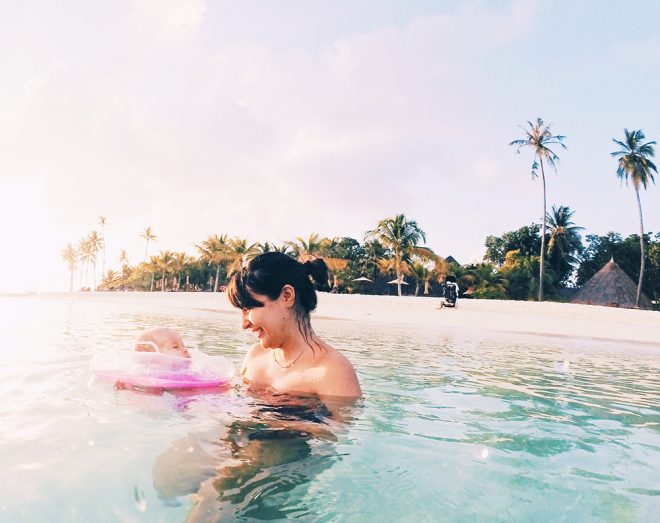
The average overwater bungalow deck drops directly into the lagoon — and most have no fence, gate, or railing of any kind. That single fact reshapes every decision you’ll make when planning a Maldives trip with a baby.
Parents take babies to the Maldives every year. Most have a genuinely good time. The ones who don’t almost always made the same set of preventable mistakes: wrong resort type, wrong island, wrong assumptions about what they could source once they arrived. Here’s what actually matters.
What Age Actually Makes Sense for a Maldives Baby Trip
Under 3 months old: don’t go. The combination of long-haul flying, boat or seaplane transfers, equatorial UV, and 80%+ humidity is too much stress on a newborn’s immune system and thermoregulation. Most pediatricians advise against long-haul international travel before 12 weeks regardless of destination.
The sweet spot reported by most families is 6 to 18 months. Resilient enough to handle the travel; young enough to be content on a beach without needing structured entertainment. A baby discovering sand for the first time is genuinely joyful. A 2.5-year-old sprinting toward an unfenced lagoon edge is a constant emergency.
Toddlers aged 2-4 can work, but only at resorts with proper beach villas — not overwater accommodations — and an enclosed shallow lagoon. The overwater experience is wasted on them and actively risky at that age.
For the 18-month to 3-year window, the Maldives trip stops being about what your child gets out of it and starts being about whether you as a parent can actually relax. Most luxury resorts offer nanny services at $25–$60 per hour on request. Four or five hours of dedicated childcare per day can shift the trip from survival mode into something resembling a proper holiday.
Getting There: Flights, Seaplanes, and the Transfer Problem
Reaching a Maldivian resort takes more steps than almost any other tropical destination, and every step has a specific complication when you’re carrying a baby.
Surviving the Long-Haul Flight
Most Western travelers route through Doha (Qatar Airways), Dubai (Emirates), or Singapore (Singapore Airlines) to reach Velana International Airport in Malé. From the US East Coast or UK, total travel time runs 14–18 hours across two flights. That means two takeoffs, two landings, two rounds of cabin pressure changes affecting baby ears, and the complete unpredictability of naps across multiple airport terminals.
Book a bassinet seat — the bulkhead row with a wall-mounted infant crib — at the time of initial booking, not later. Qatar Airways and Emirates both provide bassinets on long-haul routes; the weight limit is typically 11kg (~24 lbs). These seats fill up fast, often within days of availability opening.
An Ergobaby Omni 360 carrier ($180) is essential for airport transit. You need both hands free at security and for navigating Doha’s Hamad International or Dubai International, both of which are genuinely enormous. A carrier keeps the baby calm and leaves your hands free for boarding passes and bags.
Seaplane vs Speedboat: What Changes for Families
After landing in Malé, guests transfer to their resort by either speedboat or seaplane depending on location in the atoll chain. Seaplanes run only during daylight hours, which creates a real problem: a delayed long-haul flight can strand you and your baby in Malé overnight, waiting for the next morning’s transfers.
Seaplane interiors are compact. Luggage limits are strict — typically 20kg total per person, not per bag. Strollers go in the float compartment as separate cargo. No overhead bin, no bassinet, no standing up. Your baby sits on your lap for 25–45 minutes.
Resorts accessible by speedboat eliminate most of this uncertainty. Kandima Maldives (North Ari Atoll) is a 90-minute speedboat from Malé. Kuramathi Island Resort is similarly reachable by boat. Neither is a compromise — both have proper beaches, shallow lagoons, and genuine baby-friendly infrastructure without the seaplane gamble.
If you bring a stroller, make it the Babyzen YOYO2 ($500), which folds to carry-on dimensions and fits in overhead bins. Seaplane terminal gangplanks and resort jetties involve steps with no elevator access — a full-size travel system becomes a burden at every single transfer point.
What to Do if You Get Stranded in Malé
It happens. Build in at least 2 hours of buffer between your incoming international flight and any seaplane connection. Book the first morning seaplane departure if your resort requires one — afternoon slots risk being pushed to the next day when inbounds run late. Most resorts will cover hotel accommodation in Malé if the delay is airline-caused, but confirm this before booking and get it in writing.
What You Cannot Buy on the Islands: A Packing Checklist
Most resort islands have one small shop selling overpriced snacks, bottled water, and a few adult toiletries. The nearest proper pharmacy is Malé, a seaplane or 90-minute boat ride away. Bring everything baby-specific for the entire trip, plus 3–4 days of buffer stock for delays.
- Baby formula — Your specific brand almost certainly isn’t available on-island. Aptamil and HiPP Organic sometimes appear in Malé shops but are never guaranteed on resort islands. Bring the full trip amount plus four days extra.
- Baby food pouches — Resort kitchens at upscale properties will blend fresh food on request, and most handle this well. But branded pouches like Ella’s Kitchen or Happy Baby Organics aren’t stocked anywhere. Bring a week’s worth if your baby is on solids.
- Baby-safe sunscreen — Mustela Baby Mineral Sunscreen SPF 50 (~$20/100ml) and Thinkbaby Safe Sunscreen SPF 50+ ($15/89ml) both use zinc oxide and titanium dioxide — safer for infant skin and reef-compliant. Resort shops sell adult sunscreen at $30+ per small bottle.
- Swim diapers — Huggies Little Swimmers are not available on resort islands. Bring 2–3 packs minimum.
- Infant pain and fever medicine — Calpol (paracetamol suspension) or a US equivalent. If your baby spikes a fever mid-trip, the nearest hospital requires a boat ride plus a flight. The resort’s medical kit is not a substitute for what you know works for your child.
- Portable play yard — The Summer Infant Pop ‘n Play Portable Playard ($60) creates a contained, sand-free zone on the beach or villa deck. Packs flat and weighs under 2kg.
- White noise device — The LectroFan Classic ($50) runs all night on USB power and travels compact. Resort AC units can run loud, and ocean sound isn’t always the right frequency for infant sleep.
Which Maldives Resorts Are Actually Suitable for Babies
“Family-friendly” covers a wide range in Maldives marketing — from “we allow children” at one end to “we have a trained nanny team and a dedicated children’s centre” at the other. With a baby specifically, the features that matter are: shallow calm lagoon, beach villa access (not overwater-only), flexible dining hours, and staff experienced with infant requests.
The five resorts below represent the main options across budget ranges. Approximate nightly rates are in USD for a beach or water villa for two adults, not including meals unless all-inclusive is the property’s standard model.
| Resort | Transfer Type | Key Baby-Friendly Features | Approx. Nightly Rate |
|---|---|---|---|
| Kandima Maldives | Speedboat (~90 min) | Shallow lagoon, beach villas, flexible dining, babysitting on request | $400–$700 |
| Kuramathi Island Resort | Speedboat (~90 min) | Large island footprint, calm enclosed lagoon, multiple beach villa categories | $350–$600 |
| Meeru Maldives Resort Island | Speedboat (~45 min) | One of the largest resort islands, child-friendly pools, good shallow beach | $250–$500 |
| Four Seasons Landaa Giraavaru | Seaplane (~25 min) | Dedicated children’s program, combined beach and water villa options, 24-hour room service | $1,500–$3,000+ |
| Soneva Fushi | Seaplane (~35 min) | Soneva Kids program, trained nannies available, large beach villas with private pools | $2,000–$5,000+ |
For most families with a baby under 18 months, Kandima or Kuramathi are the practical starting points. Speedboat access removes seaplane uncertainty, both offer proper beach villas and shallow lagoons, and neither requires a five-figure weekly budget. Save Four Seasons Landaa Giraavaru and Soneva Fushi for when your child is old enough to benefit from what makes those properties exceptional.
Sun Safety and Heat: What Most Parents Get Wrong
The Maldives sits 4 degrees north of the equator. UV Index values routinely hit 11–12 — the maximum category on the scale. A peak summer day in southern France reaches UV Index 9. A typical beach morning in the Maldives delivers more UV exposure than your baby would accumulate during an entire mild-weather week in Northern Europe.
How Much Sunscreen Does a Baby Actually Need?
The American Academy of Dermatology recommends keeping babies under 6 months entirely out of direct sunlight — shade and UV-protective clothing only, no exceptions. For babies over 6 months, mineral sunscreen on all exposed skin is appropriate, but dosing matters more than most parents realize. A full-body application on a 9-month-old in a swimsuit uses 3–4ml per session. Reapplying every 90 minutes near water means a 100ml bottle lasts about 2–3 beach days. Bring more than you think.
Both Mustela Baby Mineral Sunscreen SPF 50 and Blue Lizard Baby SPF 50+ ($18) use zinc oxide and titanium dioxide — reef-safe mineral filters that the Maldivian government increasingly mandates over the oxybenzone and octinoxate found in most adult sunscreens. These formulas are better for your baby’s skin and compliant with resort environmental policies that are tightening year by year.
Recognizing Overheating Before It Becomes Serious
Babies overheat faster than adults and can’t describe it. In 32°C heat with 80% humidity, warning signs come before visible distress: unusual fussiness, warm or flushed skin even in the shade, feeding more than normal (self-hydrating), and fewer wet diapers than usual. Two or more of these together means get inside and cool down immediately.
Verify that your villa has functioning air conditioning before booking. Most luxury resorts have it. Some eco-conscious properties deliberately limit mechanical cooling — reasonable as a policy, but a dealbreaker for a family with an infant sleeping in the room.
The Overwater Villa Deck Safety Question
Ask this exact question before booking any overwater villa: “Does the deck have a gate or safety railing that would stop a crawling baby from reaching the water?” Get a written response. Some resorts have retrofitted safety gates; many still have completely open decks with a direct drop to the ocean. If the answer is vague, book a beach villa. The view from a beach villa with a shallow private pool is still definitively Maldives — without the safety calculation hanging over every afternoon nap.
Is the Maldives Worth It with a Baby? An Honest Assessment
Most families who do it don’t regret it. The environment genuinely delivers in ways that translate even when you’re on baby schedule: the water really is that color, the islands are quiet, and there are no crowded beach bars or aggressive vendors. Babies sleep well in cool AC, nap long after beach mornings, and are endlessly fascinated by shallow water. The limited-activity nature of the destination — frustrating to some adult travelers — actually works in your favor when your day revolves around nap windows.
But the logistics are harder than other tropical destinations, and the cost of mistakes is higher. Here’s the direct comparison:
| Factor | Maldives with Baby | Bali / Koh Samui with Baby |
|---|---|---|
| Pharmacy and baby supply access | Minimal — bring everything | Easy in most resort areas |
| Transfer complexity | High — seaplane or speedboat required | Low — short taxi from airport |
| Typical nightly cost (mid-range) | $350–$800 | $80–$250 |
| Crowds and ambient noise | Very low — private island feel | Moderate to high near tourist areas |
| UV intensity | Extreme (UV Index 11–12) | High (UV Index 9–11) |
| Overwater villa experience | Yes — uniquely Maldivian | Limited options, less iconic |
- Total budget under $3,000: Bali or Koh Samui serve families better at this price — better baby infrastructure, more flexibility, fraction of the logistical complexity.
- Total budget $4,000–$8,000 for 7 nights: The Maldives works. Prioritize speedboat-access resorts, beach villas, and flexible dining. Kandima or Kuramathi are the right entry points.
- Total budget $10,000+: The seaplane resorts justify themselves. At Four Seasons Landaa Giraavaru or Soneva Fushi, the staff support and built-in logistics make the trip feel genuinely effortless — even with a baby in tow.


Hi, this is a comment.
To get started with moderating, editing, and deleting comments, please visit the Comments screen in the dashboard.
Commenter avatars come from Gravatar.